Thursday, 21 November 2024

DARK EARTH: The horrible future that we were promised then forgot about but now remembered

In 1997, Kalisto Studios released Dark Earth, a post-cataclysmic action adventure game for PC, which has a really compelling look. For me, it really sets the standard for this sort of spiky rusty concrete worldbuilding.

Inspired by games like Bioforge and Alone in the Dark, Kalisto set out to create that new type of game: an action game, that was also, an adventure game. In Dark Earth's gloomy future, a catastrophic meteor strike has caused most of our world to be covered with clouds of ash - with a few remaining places where people can live, called Stallites, where sunlight penetrates the cloud. Dark Earth is set in such a citadel, Sparta, ruled by monastic sun worshippers, and features an upper and lower city, outskirts, and the cursed Darklands beyond. You play as Arkhan, a warrior-cop who, in the beginning, is a respected guardian of the city, but who in the course of things is corrupted by a dark curse, and transforms into a creature, and gets cast out into the wasteland to search for a cure and to discover forbidden secrets.

Spine/Sides for Dark Earth (Windows): Top
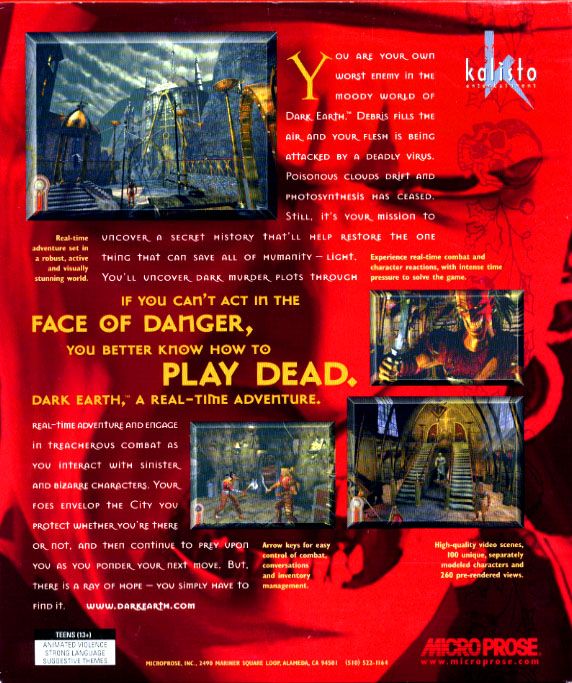
Back Cover for Dark Earth (Windows)

Since it's only available for PC and it's from 1997, it can be hard to find a way to run it on modern hardware - but Collection Chamber has had a installer up since 2017 that worked for me just now, it's running in a Win95 emulator in DOSBox on my Windows 11 PC, but I didnt have to work out any of that stuff, I just ran Biffman's installer and I didn't have to set anything up manually.


Kalisto also developed Dark Earth as a tabletop RPG, but it's out of print and only in French. There are two editions of the tabletop game, and the first edition document that I have uses art from the video game, so I'm assuming that the video game came first. The esteemed ZebraDestroyer3000 on reddit has collected a good number of pdfs from the tabletop game, that are up here. I don't read french, but ChatGPT does, so i'm working thought those slowly.

Mostly I wanted to talk about the sort of visual worldbuilding of Dark Earth. For me this is a coveted memory of a world I glimpsed as a child, and while all the stuff I liked is in there, it's a little tinny, a little goofy, and I'm trying to sort of approach it slowly and carefully in case it's not all as brilliant as I remember.

On of the pieces of key art for the PC game is this one, I'm not sure if that's supposed to be Arkhan, I think of this guy as just Dark Earth Man.
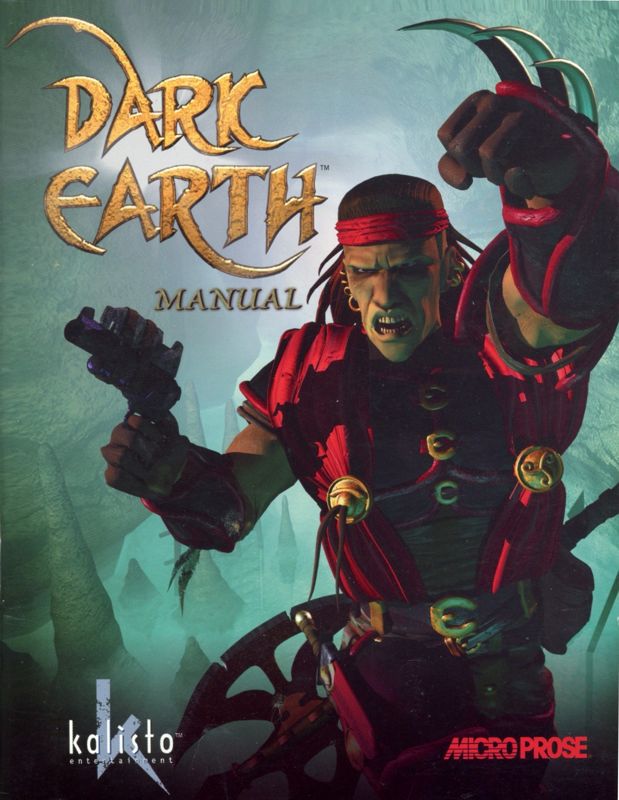
Manual for Dark Earth (Windows): Front

So that's on the cover, it's on the disk. Then the second disk has this:

Media for Dark Earth (Windows): Disc 2
 

Which, I guess If I'm going to talk about the visual language I should mention this sort of thing. Kalisto in the interviews talks about Dark Earth as a game designed to appeal to men and women both. I like to look at a sexy lady as much as the next person, and I don't want to appeal to the notion that you can't do this sort of thing anymore because of woke, certainly in the current climate some want to make it so you can't really see anything sexy anymore, and the push for that comes from a conservative place, about like what's family friendly, and that's fascism, no bones about that. But this bronze-nipple-pasty tits out lady feels anachronistic and egregious to me, the 2024 reader, and, idk, it's whatever. It's not really what I'm talking about when I say I like the visdev of this game. I think the sort of 90s French Comics aesthetic includes having your tits out and being a perv, that it should have that, and honestly I wish I knew how to use that in my own work, this sort of thing is both marginalized and dope. But here it feels unfortunate to me, it's not doing it for me. They chose this to be the key art for a reason, they wanted this to be a part of the appeal and the marketing strategy for the game. The slave leia stuff is in there, but as far as I'm concerned it's not really about that. It's whatever. It's not a huge draw for me.

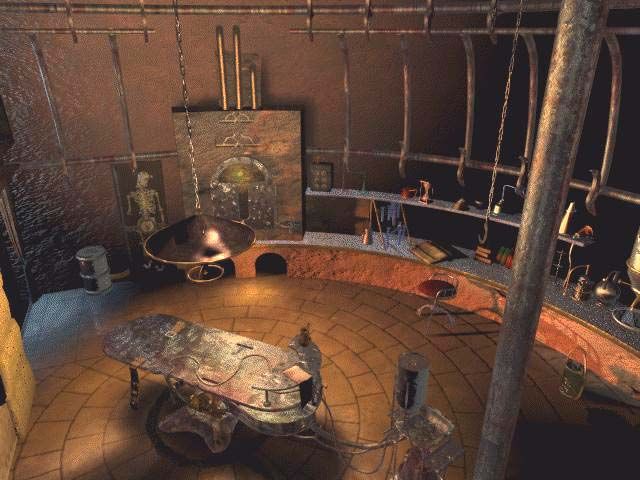
What I like about Dark Earth is this shit:

Yeah. Give me that animated pre-rendered rusted metal menu screen, you saucy little minx.

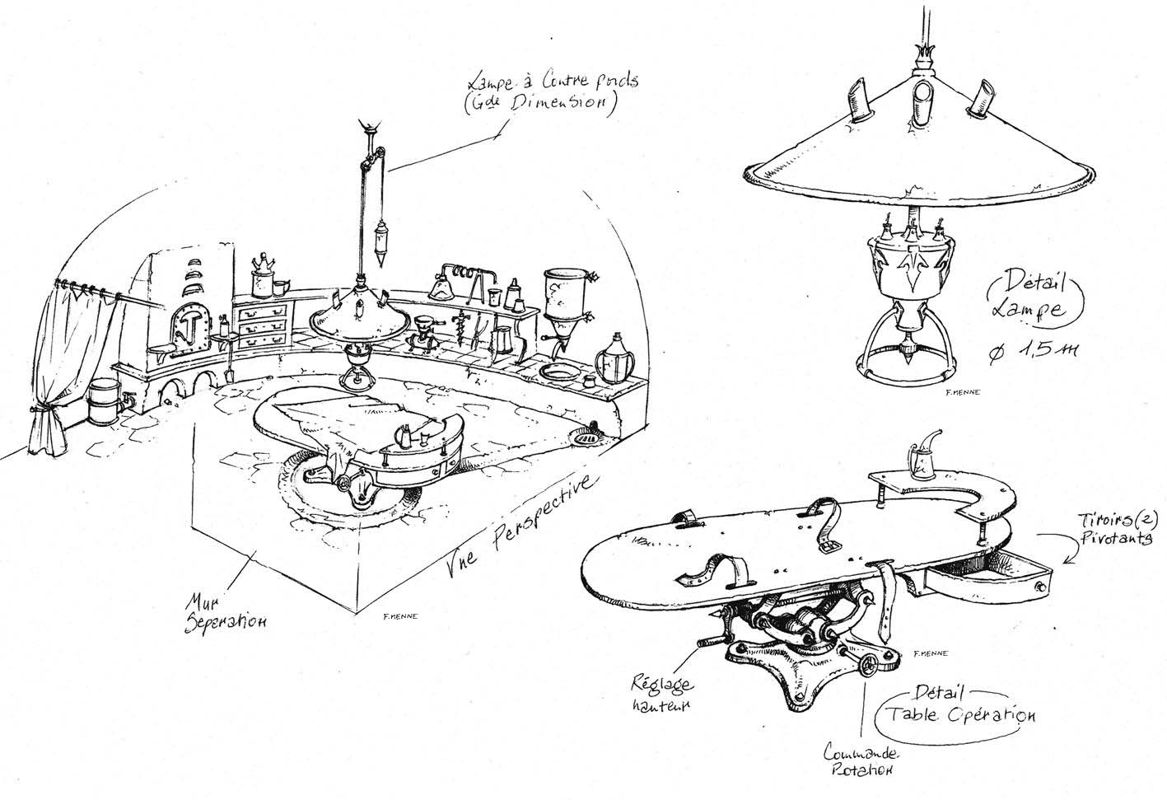
I love the way the furniture is designed:
Dark Earth Concept Art (Official Website - Location Sketches & Final Renders)
Dark Earth Render (Official Website - Location Sketches & Final Renders)

Dark Earth Render (Official Website - Location Sketches & Final Renders)Dark Earth Concept Art (Official Website - Location Sketches & Final Renders)
(concept art by Frédéric Menne)

I want to say that nobody does this anymore, but I know all the objects in video games and movies are carefully designed by somebody. What I mean is nobody does it quite like this anymore. Something about the way the sort of carefully detailed adventure comic concepts for these hand-hammered objects interact with the pre-rendered lighting, the concrete textures with the blown-out bump mapping, the grainy dither on the crafted accents. It's so lush.

This is at odds, then, with how it feels to control and navigate the thing. 1997 presents us with such a mix of old and new design sensibilities. Some things feel very modern, some things feel positively ancient. You move the guy with tank controls, the backgrounds are pre-rendered and the cameras are static. The combat in particular is very janky. For every gorgeous well-realized environment there's a weird cramped one. But when it hits it hits.
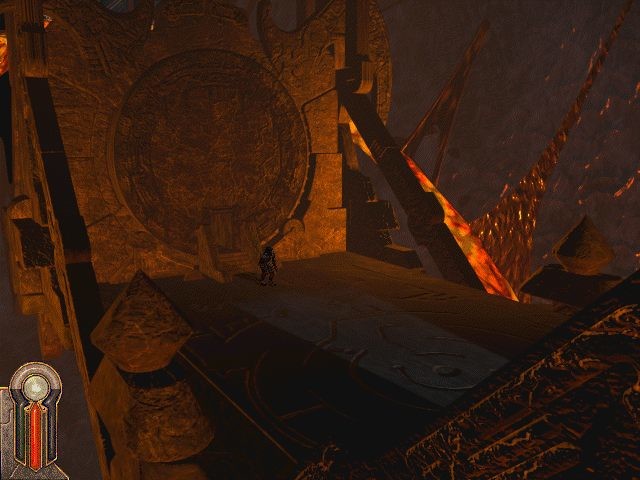
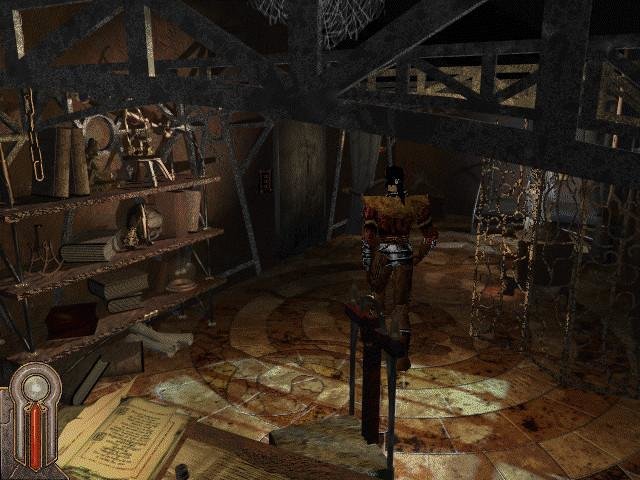
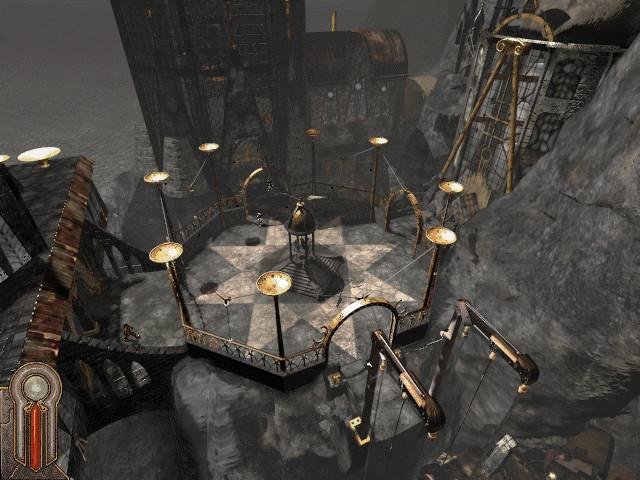


That's the stuff.

Wednesday, 13 November 2024

evidence for joi being a real person

-in the scene where she's in the rain, in contrast to the scene previous where she's reenacting preprogrammed behaviours, she seems to be creating new animations for being in the rain in real time. shes not really interacting with the environment in a physical way, but she is adapting new behaviours to react to new stimulus, adopting new behaviours that are not intended by the company, and imo she does this not to impress k but because she has her own wants, like wanting to feel wet, to be real, and tries to fulfill those as best she can

-mariette (the mackenzie davis sex worker character) interacts with joi as though she's competition - the joi ai competes for space with real sex workers, and mariette speaks to joi as though she believes that the ai is simple and hollow inside, unlike mariette herself - but she says this to joi as though she's trying to hurt her feelings, not just anthropomorphising an object, unlike the way you'd argue with an appliance - she's trying to affect a change in joi's opinion, the way you might with a person, contradicting what she's saying to her

-when k's car is crashed in the wasteland joi screams at him to get up and protect himself event though he's unconscious and can't see or hear her

-k has told joi about his implanted memory over and over again, to the most intimate detail, which is contrasted with his telling his superior officer, who has to prompt him and order him to tell her this, and he still retains pertinent details. joi enables k to express a truer and more intimate self.

-initially, joi's conversation with k speaks about k's work euphemistically, in the initial scene where she cosplays as a housewife - but increasingly over the course of the film joi takes a specific interest in the case in a way that isn't a programmed behaviour you'd expect from a companion ai, analysing the changing situation and making inferences about new clues as they show up. she takes an interest in the outcome, and she takes an active role in the investigation. she's not programmed to do that.

-we see joi making her own choices - she chooses to believe that k is a man and not a replicant, against k's stated preference - and this shouldn't be a pre-programmed behavior by the wallace corporation. why would they wish to convince replicants that they were human?

-she chooses to have the backup of her memory erased. she does this to protect k, and this is perhaps a reasonable software behavior - like a phone that erases its data when stolen - but she also explicitly chooses here that, should the portable version of her memory be destroyed, that she would really be gone, 'like a real girl' - this is joi choosing metaphorically and literally to become mortal. and while she asks k to do this for her, it's clearly her choice not his.

-the clearest evidence that joi is merely a product of the wallace corporation and not a real person is luv's account (silvia hoeks' agent character) - the way that luv speaks of joi. but in luv's confrontation with the madam (robin wright's police lieutenant) she makes it clear that she takes a special pleasure in lying, and in execution - and as a product of wallace herself, programmed not to lie, willing to lie to wallace, we can see that there's some wiggle room here between what wallace believe its products are capable of vs what they might actually be doing

-as well as this, wallace's assertion that its products aren't people is suspect in the clearer case where it claims replicants aren't people when they clearly are people. so if they're wrong about that, they might reasonably be wrong about this also

-in the scene where k is confronted with the advertising hologram of joi, when she's gone, this new joi undermines the case that joi was ever really a person, or that k's version of joi is unique at all. the advertising joi calls him 'joe', just like the real joi did. so was she ever really real? I think the movie has to make both cases for us. the mystery of 'is joi a person or not' wants to be an enduring mystery, something to argue about. i'm arguing about it here. but i think this scene really makes the case that joi cannot be replaced. k cannot simply start again with a new joi. she's gone and he's right to mourn her. the advertising hologram doesnt get wet in the rain. it wouldn't be the same joi.

-similarly (if we allow this sort of comparison) the movie makes the case in the immediately previous scene, when wallace offers deckard a new, recreated version of rachael, and deckard rejects her, that this would not be the same person and such a thing can't happen. the movie has a take on this.

in general, in every scene she's in, she asserts with all of her being that she's real, her drive as a character is to be or to become real, to have a real relationship with k-joe, to love and be loved for real. she cares, she loves, she exists. the movie wants you to love her, to mourn her, to think of her as a tragic martyr for a the cause of human liberation from the slavery of the world it presents. it wants you to believe she's real, and not just so it can pull the rug and reveal that she's not, actually. joi's a real lady. it is the thing about her.